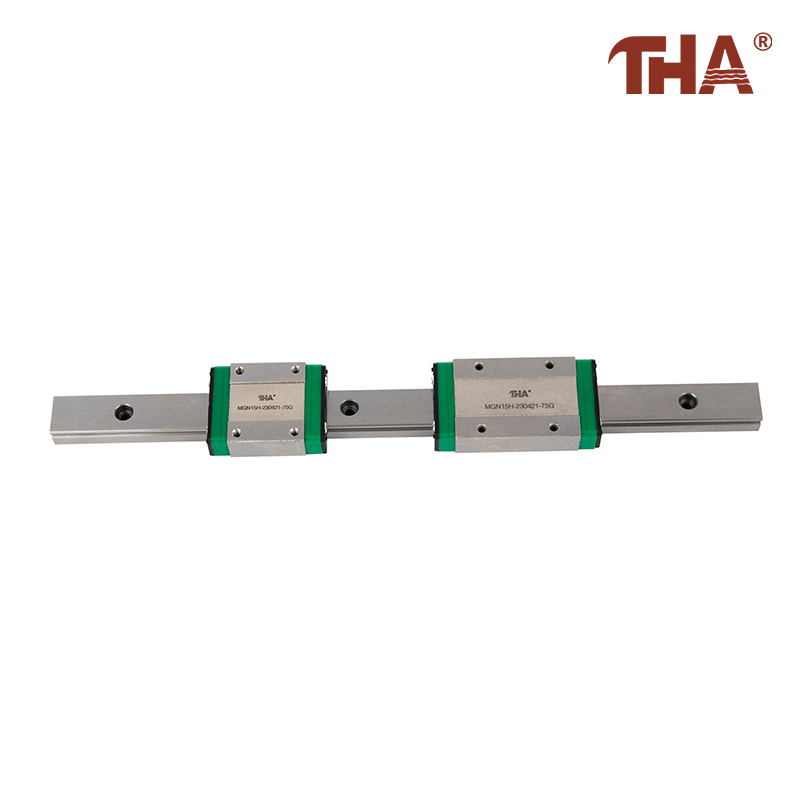
Micro guide rails, as compact precision transmission components, are frequently employed in mechanical transmission systems requiring high accuracy, such as within medical equipment, semiconductor manufacturing, and robotics. Their precision grade directly impacts equipment performance, ranging from standard to ultra-precision levels, with varying requirements for straightness, parallelism, and positioning accuracy across different applications. Consequently, learning how to assess the precision grade of micro guide rails is crucial. Currently, the following four methods are commonly employed.
I. Laser Interferometer: By measuring the deviation between the actual position and the commanded position of the guide rail slider throughout its full travel, and analysing and evaluating the data according to international standards (such as ISO or JIS), the positioning accuracy and repeatability accuracy grade of the guide rail can be directly determined.
II. Electronic Spirit Level or Self-Leveling Instrument: By securing the instrument to the slide block or worktable and moving it along the full length of the guide rail while recording data, it can precisely measure the straightness error of the guide rail in both horizontal and vertical planes, as well as the parallelism error between multiple guide rails.
III. Dial Indicator or Capacitive Displacement Sensor: Position the indicator head vertically against the side of the slide block. Push the slide block at a low, constant speed while observing the dial needle's deflection. This provides a direct visual detection of minute vibrations in the slide block caused by issues such as track flatness or uneven ball dimensions.
IV. Applying Preload to Guide Rails: Apply a preload equivalent to working conditions to the slider using specialised fixtures. Measure the positional change before and after loading. Guide rails with high precision and rigidity exhibit minimal deformation, verifying their ability to maintain accuracy under actual load conditions.
It should be noted that the precision grade testing of miniature guide rails requires comprehensive consideration of equipment accuracy requirements, testing environment, and cost factors. Conducting all tests within a temperature-controlled, vibration-free clean environment is essential to ensure accurate results. Miniature guide rails are highly sensitive to temperature fluctuations, foundation vibrations, and dust. They must be operated under controlled conditions to eliminate external interference, thereby ensuring the authenticity and validity of measurement data.
Lishui Guangyuan Industry & Trade Co., Ltd. is a leading manufacturer of high-precision linear motion components, including ball screws, linear guides, sliders, and motion modules. Many of our products hold national patents and meet international certifications. Should you require any assistance, please do not hesitate to contact us.