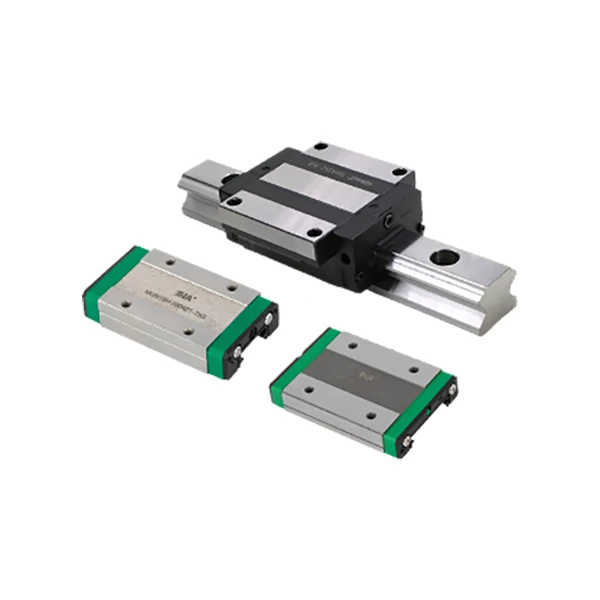
Standard ball linear rails rely on point contacts inside gothic arch grooves. Under heavy vertical plunging forces or severe interrupted cuts, those tiny point contacts build up concentrated stress, creating vibration chatter and pitting the rail tracks.
RG series roller rails replace balls with precision cylindrical rollers. The flat surface of each cylindrical roller bears against the ground track in a continuous line contact, expanding the load-bearing area by over 50%.
That extra contact area stops the rail metal from flexing under deep cutter bites. That stiffness stabilizes your machine bed during aggressive end-milling and keeps the roller blocks running smooth long after ball guides would have pitted.
2. Mounting Steps: Base Cleaning, Alignment Sweeps, and GreasingClear the Cast-Iron Ledge: Rub an oilstone over the machine ledge to scrape off paint spatters and raised burrs. Set the master rail in place, then use side jacking screws to pull its reference shoulder tight against the machine bed before tightening bolts from the center outward.
Sweep the Secondary Rail: Clamp a dial indicator onto the master rail carriage with the contact tip touching the secondary rail side. Roll the block along the stroke and adjust the secondary rail until parallelism stays locked under 0.003 mm per meter.
Purge Fresh Grease: Heavy line contact burns through oil films fast. Connect your grease gun with EP-rated NLGI Grade 2 lithium grease every 100 hours, pumping lube into the carriage fitting until fresh grease purges past the wipers.
A: Cylindrical rollers are pre-loaded (ZA or ZB preload) to eliminate all internal clearance. That initial friction creates firm axial stiffness and vanishes once the machine completes its first few warming passes.
A: Factory end wipers get chewed up fast by dry cast-iron powder. You need to snap on heavy-duty double-lip wipers, add a steel scraper plate, and plug every rail counterbore with plastic caps so dust cannot sit in the bolt holes.
Sweep secondary rails under 0.003 mm parallelism, use side push screws on master ledges, and purge EP grease every 100 hours—that covers 90% of heavy roller guide installation and life issues on 5-axis CNC machinery.