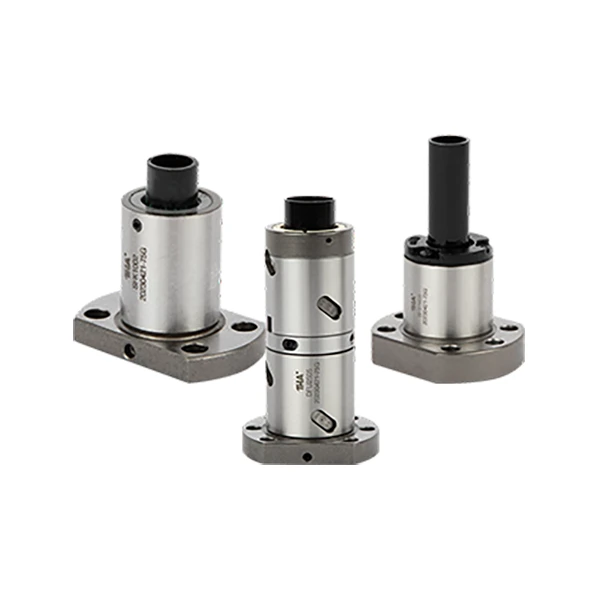
1. Why SFU Ball Screws Develop Backlash and Axis Chatter
When a CNC mill or router shows positional overshoot or surface chatter marks on finished cuts, operators often blame servo tuning. The physical cause is dynamic backlash inside the SFU single-nut assembly.
In standard SFU nuts, steel balls roll through gothic-arch raceways and recirculate through external return pipes. Under rapid 1.0 G reversals or heavy axial cutting forces, steel balls skid against the screw thread. This skidding creates micro-pitting along the ball track, widening internal axial play over time.
When that play gets slop in it, cutting forces slap the nut body back and forth along the screw thread. That slap shakes the whole carriage loose and kills your micro-step accuracy.
2. Shaft Alignment, Locknut Torquing, and Lubrication RulesDrop the screw shaft into its fixed and floated bearing blocks before tightening any bracket bolts. Clamp a dial test indicator directly onto the main carriage and sweep the nut housing face-to-face. Keep total radial runout and non-parallelism under 0.008 mm across a 1000 mm stroke—leave it out of alignment and edge-loading will score the ball tracks within weeks.
Next, lock down the fixed-end angular contact bearings. Grab a calibrated torque wrench and pull the M15 locknut to 18 N.m. Never leave this hand-tight or guess the tension, because any axial float here instantly shows up as axis backlash at the tool tip. Dab threadlocker on the threads so machine vibration cannot back the locknut off.
For grease, pump NLGI Grade 2 lithium EP grease through the nut nipple every 300 operating hours. If you run continuous oil lubrication, feed ISO VG 68 slide-way oil right into the block. Dry running will gall the ball tracks and snap the return pipes fast.
3. Quick Troubleshooting FAQA: First, check if the fixed-end bearing locknut backed off. If the bearings are tight, pull the nut and repack it with precision steel balls that are 0.002 mm to 0.005 mm larger to bump up the preload. If you are doing heavy milling, drop the single-nut setup and swap to a DFU double-nut model.
A: Two main culprits: chips and shop dirt got inside an unsealed nut, jamming the ball train, or someone pushed the feed rate way past the screw's max RPM. When the balls hit that tube elbow at high speed, they shear the metal right off.
Keep the fixed bearings torqued tight and watch for dirty grease early—that is 90% of keeping an SFU ball screw tight and quiet.